
In his August interview with Dwarkesh Patel, Dylan Patel, founder of the chip-research firm SemiAnalysis, described an AI build that could consume more than two trillion dollars a year by 2028. Its financing reaches beyond technology investors into banks, infrastructure funds, and the savings that might otherwise finance homes or government borrowing. A boom that began in software has acquired walls, cooling towers, turbines, transmission lines, and debt.
That scale has produced the question following every new data-center announcement: is this a bubble? The word can mean that valuations are too high, that useful infrastructure is financed on terms its customers cannot meet in time, or that the technology has no durable demand. Those are different claims. Evidence of an expensive stock does not establish that its customers are imaginary.
My base case is that today’s demand is real and available compute is scarce. AI can become a globally important industry without rewarding everyone now financing it. The build can eventually overshoot demand, or government and power constraints can prevent the growth already included in company valuations. Either path can produce a correction.
The historical question is who survives it. Labor-saving machinery, railways, electricity, nuclear power, and fiber produced different outcomes for their builders. Their histories suggest that financing, the ability to create paying customers, and political consent will decide who owns the AI industry as it matures.
The economics of today’s shortage
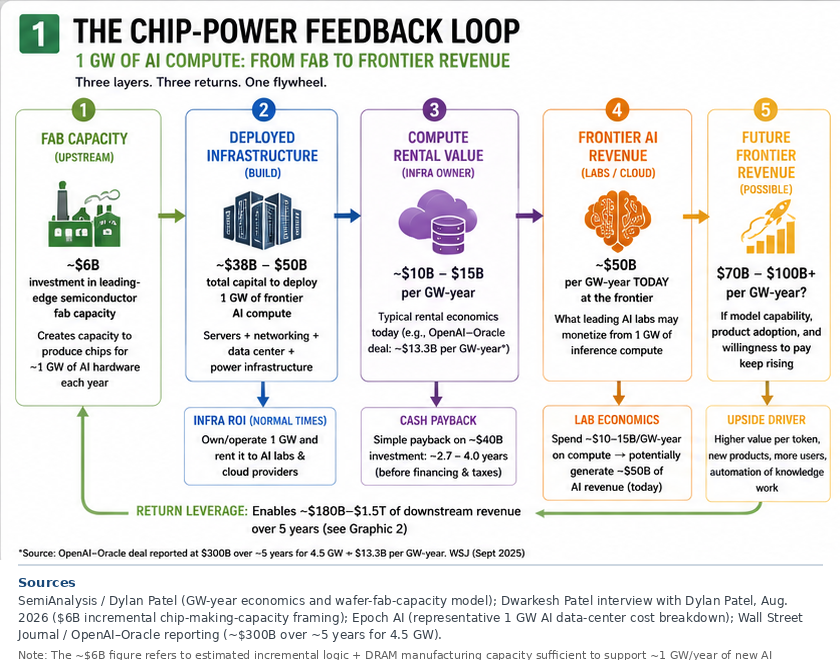
Patel estimates that renting a megawatt of AI capacity costs $10 million to $15 million a year, while Anthropic generates about $50 million in annual revenue per megawatt it uses. He expects the latter figure to reach $70 million to $80 million by the end of 2027. These are estimates of the revenue supported by scarce capacity, not audited returns on a data center. They nevertheless explain why companies are competing so aggressively to secure it.
Construction is meant to end the shortage that makes today’s capacity valuable. If it succeeds, compute prices fall and the industry has to sell more intelligence to maintain its revenue. A profitable unit today can attract enough investment to make the next unit less profitable. The present shortage and a future overbuild can belong to the same cycle.
The economics in detail: revenue, cost, and growth
The graphic separates chip-factory capacity, deployed infrastructure, compute rental value, and lab revenue. Those are different businesses and different denominators. Dividing a lab’s revenue by an infrastructure owner’s construction cost would not establish that owner’s payback. Training, serving, staff, power, depreciation, and financing still have to be paid.
Company disclosures support rapid growth, while leaving considerable uncertainty about durable margins. Anthropic reported in May that its revenue run rate had exceeded $47 billion, alongside a $65 billion equity raise. A run rate annualizes a recent period; it is not revenue already collected over a year. New equity provides time to build but does not establish that the operating business funds itself.
For the operators, the test is paid utilization and cash generation after operating costs. For a lab, it is the margin on completed work after serving costs, alongside the spending required to develop its next model. Aggregate growth can conceal very different results at those two levels.
The two ways the build can break
The first failure is a build that cannot happen. A company priced to multiply its capacity must obtain electricity, connections, land, equipment, and permits. If those arrive late, existing capacity can remain scarce while the company misses the growth its investors paid for.
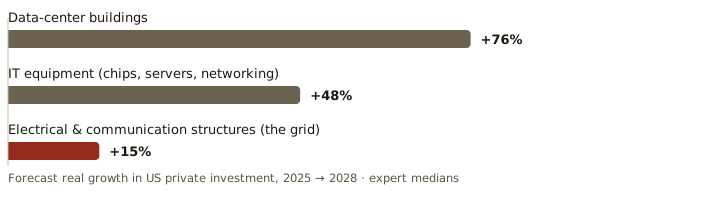
The Forecasting Research Institute’s August panel expects US investment in data-center buildings to rise about 76 percent from 2025 through 2028, compared with about 15 percent for electrical and communications structures. These broad investment categories are an indicator of a possible bottleneck, not a count of completed buildings and usable grid connections.
The second failure is a build that succeeds beyond what customers can absorb. Capacity ordered during scarcity arrives into a cheaper market. Usage keeps rising, but prices and margins fall. Customers take longer than expected to change how they work, while the infrastructure owner still owes interest and rent.
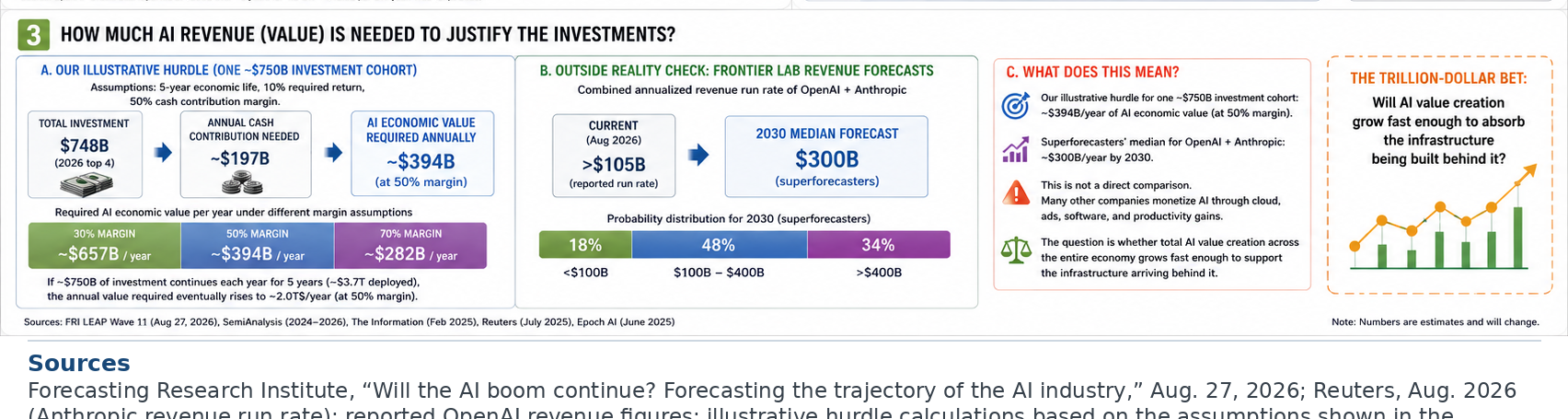
Aswath Damodaran’s August valuation exercise asks a different question from Patel’s operating analysis: how much future revenue would justify the price of the companies? In one scenario, a $2 trillion Anthropic valuation requires roughly $1.2 trillion of annual revenue after ten years, assuming a 30 percent after-tax operating margin and a 10 percent required return. That is a conditional valuation hurdle, not a revenue forecast.
The economics in detail: two different revenue hurdles
The graphic’s approximately $394 billion annual revenue hurdle belongs to an illustrative $748 billion investment cohort, using its stated capital-recovery and margin assumptions. It is not a forecast of next year’s revenue or a valuation of the entire AI industry. Its reported August run rates are annualized snapshots, while the 2030 figure is an outside forecast.
Damodaran’s company valuation exercise asks what one business must eventually earn to justify a price paid for its equity. An industry can produce enough revenue to support some new infrastructure without producing enough profit for every current valuation. The two calculations should not be added together.
Both tests depend on who collects the revenue. Productivity gains retained by customers can justify using AI without justifying the amount investors paid for its providers. Falling prices, training expenditure, competition, and the time needed to deploy new capacity can each change the result.
The weavers: profitable replacement, violent resistance
Edmund Cartwright was a clergyman who patented a power loom in 1785. His own mill failed, but later engineers and manufacturers made mechanized weaving commercially effective. Mills could produce cloth with less labor per yard, giving owners a direct source of savings: work previously paid for in weavers’ wages. Consumers gained cheaper cloth, and successful millowners expanded, while handloom families had to accept lower piece rates or find other work. The Science Museum Group records both Cartwright’s financial failure and the spread of his invention.
The workers did not accept that transition quietly. During Lancashire’s 1826 uprising, crowds destroyed more than a thousand power looms; troops fired on protesters at Chatterton. Recession and hunger intensified the conflict, and mechanization continued despite the attacks. The records of the 1826 uprising show a technology promising commercial savings becoming a target of organized resistance. AI’s opportunity to replace paid work is similarly larger than the software budget, but collecting part of the wage bill creates losers with reasons to organize against it.
The full story: the weavers, Cartwright, and their advice
Cartwright’s first machine established a principle that his business could not profitably deliver. He gave up the Doncaster works in 1793 after heavy losses. When manufacturers later adopted improved looms, they supported a petition on his behalf, and Parliament awarded him £10,000 in 1809. Even this history of profitable labor replacement contains a failed pioneer.
The 1826 Lancashire attacks belong to a particular crisis and should not be collapsed into every earlier Luddite protest. Trade contracted after the financial panic of 1825; food prices and unemployment worsened distress. The Lancashire uprising project describes crowds targeting power looms and the army’s fatal intervention at Chatterton. Machinery was both an immediate target and a threat to the weavers’ future livelihoods.
The economic gain was not a pound-for-pound transfer of every lost wage to the owner. Competition could pass savings to buyers through cheaper cloth. But a manufacturer could justify investment against work already being paid for, giving it a more immediate source of demand than a new transport network waiting for traffic.
The weavers’ advice, reconstructed: Count the people who lose income as carefully as the hours the machine saves. Their opposition will concern wages, bargaining power, and who receives the gains. A cheaper product does not give every displaced worker a new livelihood.
Cartwright’s advice, reconstructed: Proving the machine works is only the first investment. Ask whether you can operate it economically, reach customers, and keep the gains before better-financed competitors copy the idea.
Hill survived. Morgan gained control.
James J. Hill began with a distressed Minnesota railroad and built it into the Great Northern, reaching the Pacific in 1893. He expanded in stages, controlled construction costs, and developed freight customers along the route. Rival transcontinentals had also opened valuable territory, but their traffic could not support the debt through the depression that followed. Northern Pacific, Union Pacific, and the Santa Fe entered receivership. Hill’s Great Northern stayed out. Its survival, described by the Minnesota Historical Society, made Hill an owner through the crisis rather than a seller forced into court.
J. Pierpont Morgan was the banker able to organize new capital and impose terms on distressed railroads. Northern Pacific’s 1896 reorganization records show the mechanism: replace an unsustainable financial structure so the railway can keep operating, with investors accepting losses and new controls. Hill later joined Morgan in consolidating the northwestern systems. The technology’s usefulness did not protect every original owner. The winners included the disciplined builder who survived and the financier able to recapitalize competitors after their creditors lost patience.
The full story: Hill, Morgan, and their advice
Hill’s starting point was itself a distressed asset: he and partners bought the nearly bankrupt St. Paul and Pacific in 1878. Expansion required both track and freight. Hill promoted agriculture along the route and invested in operating efficiency so customers could ship at rates that still left the railway a return. Survival depended on costs as well as the eventual importance of the network.
Morgan did not personally acquire every failed transcontinental. Northern Pacific is the specific comparison here: it entered receivership in 1893 and emerged under Morgan’s reorganization in 1896. The Northern Pacific records document the sequence. Bondholders’ rights, fixed charges, fresh capital, and management control had to be reconciled against the business the railway could actually support.
Hill’s independence refers to avoiding a forced reorganization during the panic, not permanent separation from finance or consolidation. In 1901 he and Morgan combined their interests in Northern Securities; the Supreme Court ordered its dissolution in 1904. The Hill biography follows that second stage. Financial survival created an opportunity to concentrate ownership, which then attracted government action.
Hill’s advice, reconstructed: Build against customers who can pay. Test the route, the operating cost, and the customer’s own business. A signed compute contract is strongest when the buyer can meet it without another fundraising round.
Morgan’s advice, reconstructed: Match the debt calendar to the cash the business can generate. Preserve capital and borrowing capacity for a restructuring. Useful infrastructure can become available below its construction cost when its owner must refinance.
Insull: build the utility, negotiate the rules
Samuel Insull, formerly Thomas Edison’s secretary, took charge of a Chicago electricity company in 1892. He built larger generating stations and found customers whose needs came at different times, spreading the cost of the equipment over more sales. Cheaper electricity encouraged motors, appliances, and new uses, helping turn a specialized service into everyday infrastructure. Sam Altman’s March 2026 utility comparison makes the parallel explicit: intelligence supplied in quantities customers can buy and use throughout the economy.
Insull also wanted a political settlement. In a 1910 speech he argued that monopoly obligations included public supervision of rates and finance: reliable private investment in exchange for regulation, rather than endless duplication of competing wires. That bargain helped establish the utility model, although it did not save his heavily leveraged holding companies when they collapsed in 1932. Electricity service outlasted his control. The AI question is whether a provider can make intelligence cheap and dependable enough to become essential, then accept public obligations that make its scale politically durable. The proposal predates his collapse in Insull’s collected speeches.
The full story: Insull’s customers, regulatory bargain, and advice
Electricity plants incurred substantial costs before selling their first unit. Insull’s customers helped each other when their peaks differed: an industrial load could use capacity that another customer needed at another hour or season. Better utilization supported lower prices and further sales. His 1914 address on centralizing energy supply gives examples of combining different industrial and commercial demands.
His 1910 address, “The Obligations of Monopoly Must Be Accepted,” connected the right to operate a monopoly with public scrutiny of prices and securities issuance. Regulation was part of his industry-building approach. It could restrain the company while also making the terms of long-term investment more predictable.
The financial structure eventually outran that operating achievement. Holding companies concentrated control through layers of securities and borrowing. Banks refused to renew notes as the Depression deepened, and the investment companies entered receivership in 1932. The Insull archive chronology records the financing crisis and his later acquittals. Strong technology and a regulatory bargain could not make every security safe.
AI differs at a crucial point. A local electricity network has physical advantages from avoiding duplicate wires. Models can compete across the same network, run on different hardware, and in some cases run on a customer’s own machine. Metering intelligence does not by itself establish a natural monopoly or justify utility-style exclusivity.
Insull’s advice, reconstructed: Help customers find valuable uses for the input and make the service dependable enough to trust. Negotiate who pays for expansion and what the public receives. Keep the financing able to survive slower adoption, even if the operating system is sound.
Nuclear: government can stop a completed investment
Mario Cuomo became New York’s governor in 1983 as Long Island’s Shoreham nuclear plant approached completion amid fierce local opposition. Critics disputed whether the surrounding population could be evacuated safely. Cuomo supported keeping the plant closed and negotiated a settlement under which its owner, Long Island Lighting Company, agreed never to operate it as a nuclear facility. A full-power federal license in 1989 did not reverse the outcome. The state power authority acquired Shoreham in 1992 and decommissioned it. New York State’s audit of Shoreham documents a completed investment denied a commercial future.
Shoreham makes the political risk concrete. Opposition, permitting, litigation, and financial concessions can stop a project even when the equipment exists. Across US nuclear construction, regulation interacted with slower demand growth, rising costs, and expensive finance; the Energy Information Administration identifies all of them. A comparable nationwide end to AI is less likely because existing models can be copied, relocated, and sometimes run locally. But frontier training and large-scale deployment still need power and permission. Government can restrict that expansion without eliminating the technology people already have.
The full story: Shoreham, the nuclear slowdown, and Cuomo’s advice
Shoreham’s outcome was not simply a federal regulator refusing to license a reactor. Federal officials approved an emergency plan without local participation, and the Nuclear Regulatory Commission issued a full-power license in April 1989. The state settlement nevertheless committed the owner to closure. Decommissioning followed the transfer to the Long Island Power Authority.
The settlement also distributed the loss. Its terms restored the utility’s financial condition through a regulatory arrangement that included higher rates. Residents who received no commercial nuclear power from Shoreham still helped bear its cost. Public opposition can defeat a project without shielding the public from its financing.
The broader nuclear slowdown began before Three Mile Island. Electricity demand grew more slowly than utilities had expected, construction became more expensive, and higher financing costs magnified the effect of delays. Safety requirements and licensing challenges added further uncertainty. Nuclear generation continued; the new-build pipeline contracted sharply.
For AI, rules favoring a licensed incumbent, barriers to entry into regulated occupations, or lengthy approval processes could restrict competition and adoption. Conversely, clear safety standards and predictable grid approvals could make investment easier. The effect depends on the rule and who can comply, not simply on the presence of government.
Cuomo’s advice, reconstructed: Technical completion does not settle a public dispute. Find out who bears the electricity bill, the local risks, and the cost of failure. A community with power to withhold cooperation can change the economics of a national plan.
Winnick: the network outlived the overbuild
Gary Winnick, a former bond salesman, founded Global Crossing in 1997 to build an international fiber network. The internet was growing rapidly, but rival carriers built overlapping routes while improved transmission equipment increased the capacity of fiber already laid. Prices came under pressure and paying traffic could not support all the investment. Global Crossing filed for bankruptcy in January 2002, less than five years after its founding. Wharton’s contemporary account described a company with an extensive network and too little paying business to cover its costs.
The network remained useful after the original financial structure failed. Global Crossing emerged from bankruptcy, continued carrying traffic, and was acquired by Level 3 in 2011, as Level 3’s 2011 annual report records. Rising internet use eventually absorbed much of the industry’s excess capacity, helping make bandwidth cheaper for later businesses. That does not mean every strand was eventually lit or every route paid. AI could follow the same pattern of expanding use and failed owners, with a harder limit: buildings, power connections, and fiber can retain value longer than rapidly superseded computing equipment.
The full story: fiber’s excess capacity and Winnick’s advice
The Federal Reserve’s account in July 2001 distinguished an excess of long-distance capacity from shortages in local connections. Traffic was still roughly doubling annually. The problem was the combination of competing networks, technology that put more traffic through each fiber, and projects approved before their rivals’ capacity had arrived. Fast demand growth was insufficient to validate every simultaneous build.
Unused fiber by itself was weak evidence of waste. Once a trench was open, adding extra strands could be inexpensive compared with digging again later. The important distinction was between cheap reserve capacity in a sensible route and an entire network whose purchase price, operating expense, and financing assumed revenues it could not earn.
Global Crossing’s later acquisition provides a specific result rather than a claim that every boom-era cable became valuable. A functioning international business survived into another ownership structure. The benefit to subsequent network users and owners did not repay the investors whose claims had been impaired in bankruptcy.
With AI, the residual asset must be identified. Land, cooling, power access, and buildings may remain useful; an older accelerator may still run economical workloads but face a much lower rental price. The resale value of the site cannot be inferred from what its first owner paid for the chips.
Winnick’s advice, reconstructed: Add up the capacity your competitors are ordering and the extra output each new generation of equipment delivers. Growing demand can coexist with falling prices. Test whether your own network earns enough at those lower prices before the next debt payment.
Debt maturities decide who has to sell
In a correction, the first forced sellers are likely to be owners with large fixed obligations, concentrated customers, and debt coming due before their assets generate enough cash. An indebted data-center developer or compute lessor cannot wait indefinitely for demand to catch up. The useful question is how long each owner can operate if refinancing becomes expensive or unavailable.
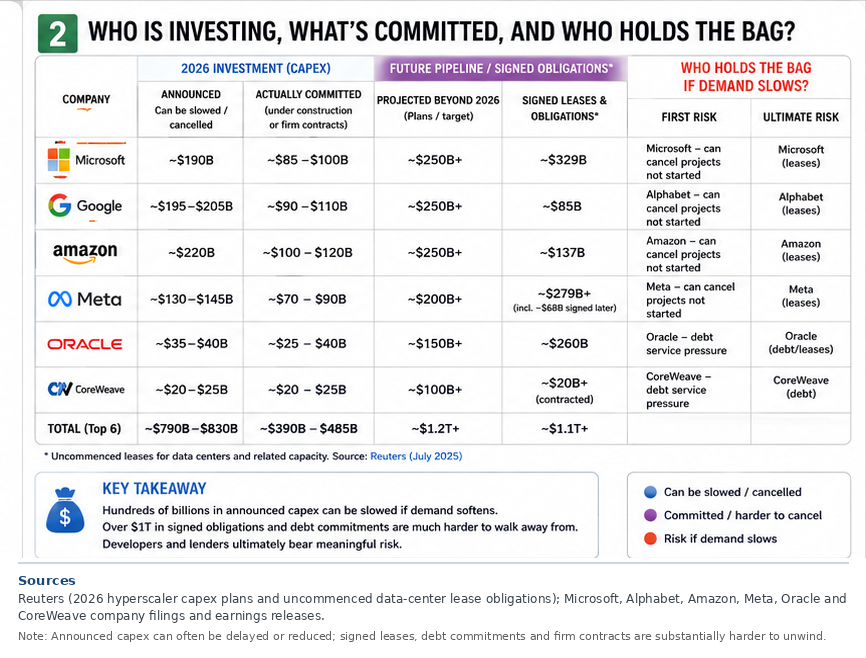
The graphic distinguishes spending plans from commitments and obligations. Microsoft, Alphabet, Amazon, and Meta can support investment with large existing businesses and can slow projects that are not yet committed. A heavily borrowed specialist has less room to absorb lower rental prices or a delayed customer. Oracle sits between these categories: it has an established operating business as well as substantial infrastructure obligations. Its risk belongs in the comparison rather than defining it.
The contrast appears in current filings. CoreWeave’s June 2026 debt schedule lists $4.4 billion of principal payments in the rest of 2026 and $6.2 billion in 2027, against $5.5 billion of cash at quarter-end. Customer receipts and access to new capital therefore matter alongside the assets. Microsoft reported $182.9 billion of operating cash flow for its fiscal year. Much of that cash is needed for Microsoft’s own commitments. Its scale nevertheless illustrates the difference in financial capacity.
My base case is that the first major failures occur among leveraged infrastructure owners, rather than the hyperscalers or the leading labs. The labs have capital, valuable products, and strategic backers, but they are not financially identical to cash-generating hyperscalers. Their survival still depends on the cash they have, the commitments they have signed, and customers paying enough to cover the service. A funding round buys time; it does not remove those obligations.
Hill’s Great Northern was not the railroad forced into receivership in 1893. Northern Pacific was. The distinction for AI will likewise be the owner’s financing and operating business, not whether its assets belong to an important industry. The next Morgan is likely to be a company or group of investors with cash and borrowing capacity left when others must sell. A hyperscaler buying a power-connected site at a discount could strengthen its position while the original owner loses its equity.
The financing in detail: what the graphic can and cannot establish
The spending graphic is a comparison of exposure, not a complete debt-maturity schedule or a solvency ranking. It mixes announced capital budgets, contractual commitments, and different reporting periods. These should not be added into one debt total. To identify the first forced seller, compare cash and operating cash generation with interest, debt maturities, lease payments, collateral requirements, and the reliability of customer receipts.
A long lease and a bond due next year create different pressures. A lease may burden margins for years; a maturity creates a concentrated need for repayment or refinancing. Customer prepayments and enforceable contracts can reduce risk, but a contract from a customer dependent on new funding is not equivalent to cash already received.
The financing loops matter for the same reason. Investment by a cloud or chip supplier can help a lab buy that supplier’s services. Such a relationship is not proof of fictitious revenue. It makes the ultimate source of demand important: how much money comes from customers whose own businesses can keep paying if investment in AI slows?
The graphic does not establish that any named company is insolvent. The case’s prediction concerns the conditions that produce forced sales. The tracking test is a disclosed maturity or lease burden that cannot be met from cash, contracted receipts, and continuing operations without new capital.
The token is not the product
People bought electricity because it lit a room, powered a motor, or heated an iron. Insull’s demand creation extended beyond generating a cheaper unit. He needed customers to own useful equipment and use it often enough to support the system. In his collected speeches, he described an electric-flatiron campaign and said lower rates encouraged heating appliances. Useful products gave electricity a larger market.
AI customers similarly want completed work: a resolved service ticket, working software, a finished design. The cost includes the model, tools, data, retries, integration, and human supervision. A cheaper token helps, but the customer pays for the reliability and value of the result. This gives labs a reason to build applications and agents that make their intelligence easier to use.
A lab can subsidize adoption through free entry tiers, bundled applications, credits, or help installing a product. It might earn little on an introductory service if that service creates durable demand for the wider system. That strategy has to be judged by subsequent paid use and retention. Giving away work indefinitely would increase the funding requirement rather than establish a business.
Integration gives the lab another possibility: keep more of the value by controlling the product as well as its model, and reduce the total cost by optimizing the model with the infrastructure that serves it. OpenAI or Anthropic need not own every chip factory, power station, and application. They need enough control over supply, performance, and the customer relationship to make completed work economical.
There is also a limit in Insull’s example. Selling more appliances could enrich the electricity supplier without giving it ownership of every appliance business. Independent AI applications may similarly use inexpensive models and keep the customer relationship themselves. The utility parallel supports a vast market for intelligence; it does not establish that today’s labs will capture most of that market’s profit.
The product argument in detail: appliances and paid adoption
Insull’s collected speeches, printed pages 101–102, document the flatiron campaign and his comments on rates and appliance use. They do not establish that he sold every appliance at cost or subsidized their purchase. The narrower historical claim is sufficient: the supplier actively promoted uses for its service rather than waiting for demand.
For a lab, the equivalent test is whether introductory spending leads to repeat customers whose payments exceed the cost of serving them. Cost per successfully completed job, renewal rates, and the share of work completed without human repair are more revealing than the number of free tokens distributed.
Applications can also create new work rather than replace an existing bill. Smaller firms may buy analysis or software they previously could not afford. That expands the potential market, but adoption takes time and competitive pricing can leave much of the gain with customers. The financing must survive that transition.
Perez, Wu, and Thompson: the cycle, control, and integration
Carlota Perez distinguishes installing a technology’s infrastructure from deploying it throughout the economy. Financial enthusiasm can accelerate construction beyond what users are ready to absorb; a correction and institutional changes can precede wider productive use. Applied to AI, her framework makes a future investment crash compatible with a successful technological transformation. It does not date that crash or prove that every new technology requires one.
Tim Wu’s The Master Switch asks who gains control as an information industry develops. Open experimentation can give way to a few owners of essential infrastructure and distribution. AI’s capital requirements and the acquisition of distressed assets could strengthen that concentration. The practical question is whether independent developers can still reach customers and switch providers once the infrastructure has consolidated. Policy and new technology can reopen a system as well as close it.
Ben Thompson’s analysis of integration and modularization asks which layers benefit from being designed together. When reliability and performance fall short, coordination across a model, its tools, and its application can produce a better result. When interchangeable components become good enough, modular systems offer choice and competitive prices. His account also explains why a superior integrated user experience can retain value even after cheaper alternatives arrive.
For AI, that leaves room for both structures. Open models can make intelligence widely available, while integrated products compete on dependable execution and ease of use. Google, Microsoft, and other owners of infrastructure and distribution can pursue that opportunity too; it does not belong automatically to an independent lab. The decisive test is whether integration produces a lower cost per successful job or merely makes switching harder.
My reading of the three frameworks is that a correction can transfer infrastructure to stronger owners, those owners can integrate it with products and distribution, and that concentration can provoke regulation. The sequence is plausible rather than inevitable. Evidence that independent applications routinely switch models without losing performance would weaken the integrated-lab case even while strengthening the case for AI adoption.
The frameworks in detail: what would change the conclusion
Perez: track whether investment growth is being followed by sustained productivity and new commercial uses. A long period of paid deployment without a severe capital correction would weaken a simple crash-then-growth account.
Wu: track control over distribution, access to compute, and the ability of independent firms to compete. Concentration in infrastructure need not imply concentration in every application, particularly if customers can switch models or run them locally.
Thompson: compare integrated and modular systems on the same completed tasks, including failures, supervision, latency, and switching cost. Better performance would support integration as an economic advantage. Similar results from interchangeable components would support a more modular industry.
These are applications of the authors’ frameworks to this case. They should not be read as a joint forecast by Perez, Wu, and Thompson that a particular lab will win.
My base case is that AI’s current build responds to real demand. I do not think the evidence establishes an industry-wide overbuild today. Valuations can still be too high, individual projects can already be speculative, and the next wave of capacity can change the economics. I expect a correction as supply, adoption, and financing move at different speeds, but its timing remains uncertain.
The first major losses are more likely among leveraged infrastructure owners than the cash-rich hyperscalers or leading labs. Debt maturities, lease burdens, and customer funding will determine who has to sell. The companies with cash and operating strength at that point can acquire useful capacity and emerge larger. Hill’s survival and Morgan’s reorganizations are the closest historical tests of that part of the case.
I expect one or two labs, or companies built from them, to reach GM-like scale by moving into products, securing their infrastructure, and selling completed work across the economy. The strongest challenge is that models become interchangeable while applications and distribution capture the profits. Cheap intelligence would still transform the economy under that outcome; the labs would capture less of its value.
A successful integrated company will also need a political settlement. Insull shows how public obligations can help make private infrastructure durable. The weavers show why replacing paid work produces resistance. Nuclear shows how that resistance can stop investment. Fiber shows how the public can benefit from a build whose first owners lose money.
I will review this ruling quarterly, next on December 1, 2026. I will revise it if paid utilization and rental prices fall together across major providers, if the leading labs cannot cover serving costs on paid work, if modular applications consistently match integrated products at lower total cost, or if power and regulation prevent the expected expansion. Those observations would change the timing, the likely owners, or the central thesis, rather than simply adding another opinion to the bubble debate.
The eleven signals below turn the case into observations that can change the ruling. Revenue, prices, financing, deployment, and political consent must be tracked separately: growth in one does not establish strength in all the others.
Revenue per megawatt. Track paid revenue per megawatt against Patel’s $70–80M end-2027 estimate, alongside serving costs and utilization. A higher figure alone does not prove that wage spending has been captured.
The price of compute. Rising on scarcity, or collapsing the way bandwidth did. CME's planned compute futures would put this price on a public tape from October.
The financing mix. Cash flow giving way to debt, vendor financing and off-balance-sheet deals; spreads drifting from 6 toward 8 percent.
The payroll data. Real displacement in high-paid work: entry-level hiring in software, law, finance.
Deployment blockers. Data-center moratoria, state laws gating AI from named occupations, utility-rate ballot fights.
The electric bill. Whether data-center power costs become a national political issue before any AI benefit does.
The first big workout. A neocloud or data-center operator restructured, capacity sold at a discount to build cost.
Depreciation honesty. GPU useful-life schedules stretching while replacement cycles shorten, until auditors or short sellers call it.
The growth tell. Productivity in the statistics, not the keynotes: TFP, output per hour, real wages in adopting sectors.
The outside-money share. Compute revenue that would survive the fundraising stopping tomorrow.
The inference margin. Paid usage keeps selling above its serving cost as token prices fall; a reported gross margin going negative at scale means the growth is bought.