The Script That Always Plays Out: Why America's Immigration Enforcement Crises Follow the Same Pattern Every 70 Years
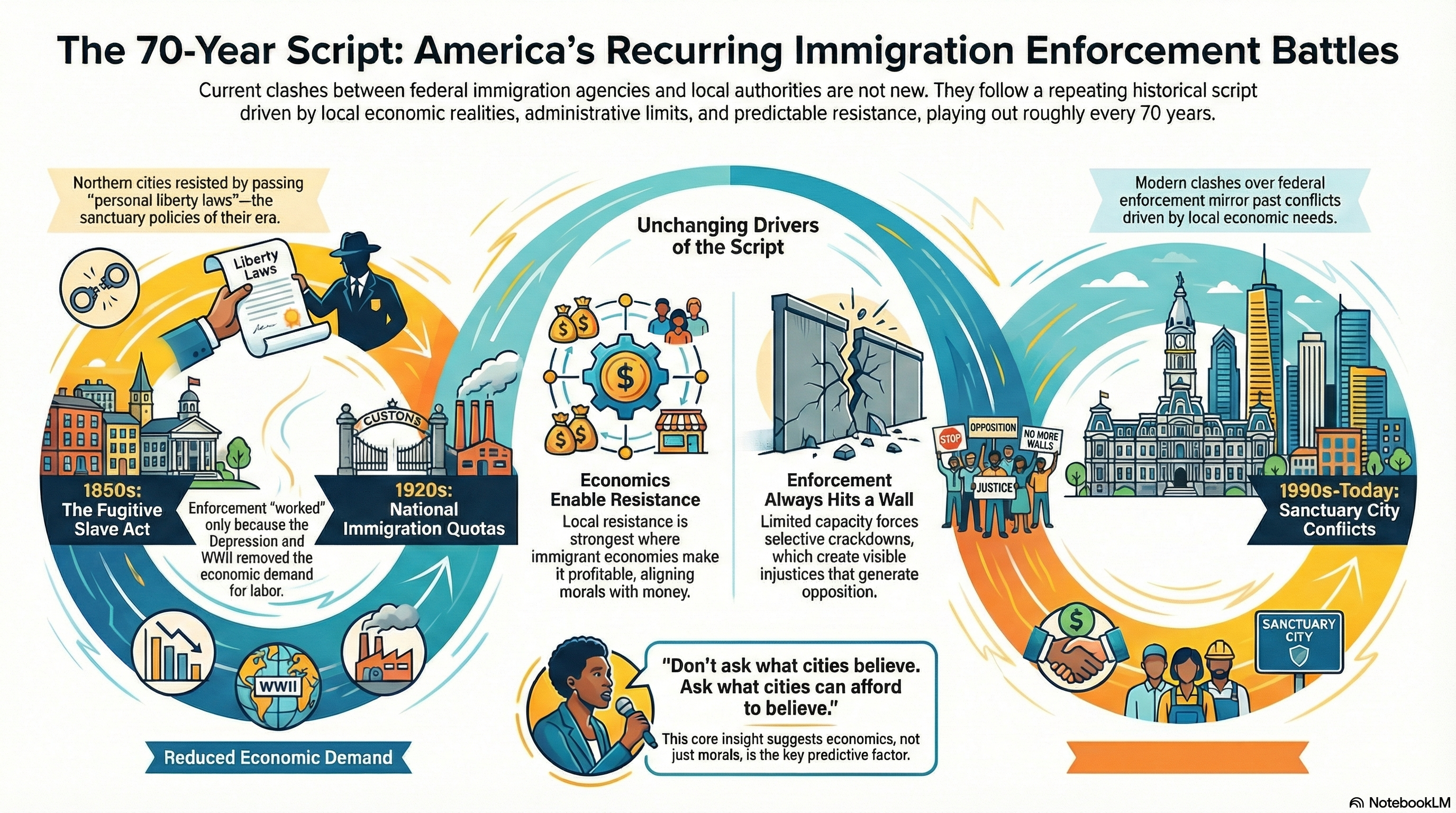
Federal enforcement promises, capacity constraints, selective crackdowns, local resistance where economically viable—the cycle repeats because the underlying incentives never change.
“Don't ask what cities believe. Ask what cities can afford to believe.”
— Pattern Lab analysis
Here's what everyone gets wrong about the current ICE enforcement battles: they're not unprecedented, they're not primarily about morality, and they're certainly not about whether enforcement will 'work.' We've run this exact script before—in the 1850s with fugitive slave catchers, in the 1920s with immigration quotas, and now with sanctuary cities.
On June 2, 1854, federal marshals marched a single man through the streets of Boston.
Anthony Burns was an escaped slave. His owner had tracked him to Massachusetts and demanded his return under the Fugitive Slave Act. The federal government was determined to prove that the law would be enforced—even in the heart of abolitionist territory.
What happened next should sound familiar.
Fifty thousand Bostonians lined the streets in protest. Local officials refused to help. The mayor called it "kidnapping under color of law." Abolitionist lawyers filed every motion they could invent. A crowd tried to storm the courthouse. One federal deputy was killed in the chaos.
President Franklin Pierce sent the Marines, the Army, and the Navy. Cannons were positioned on the courthouse steps. It took 2,000 armed men to march one escaped slave to the harbor.
The cost to return Anthony Burns to slavery: $100,000—roughly $4 million today. For one man.
The federal government had won. The law was enforced. The precedent was set.
And it meant nothing.
Within seven years, the Union was at war. The Fugitive Slave Act's "successful" enforcement had done nothing but expose the gap between federal authority and local reality. The harder Washington pushed, the more resistance crystallized. The more resistance crystallized, the more force was required. The more force was required, the more the whole system looked illegitimate.
This is the script that always plays out. Federal government promises comprehensive enforcement. Enforcement hits capacity constraints. Selective enforcement begins. Visible injustices generate resistance. More force delegitimizes the policy further. The cycle continues until external shocks reset the board.
We've run this script three times in American history. We're running it again now.
The Comfortable Lies Both Sides Tell
The conventional narrative splits neatly along partisan lines: either current ICE enforcement represents unprecedented federal overreach, or sanctuary cities are lawlessly obstructing legitimate authority. Both framings are wrong—they treat this moment as unique and primarily moral.
The 1850s fugitive slave crisis was about Northern commercial cities that sometimes enforced the Fugitive Slave Act when merchants needed Southern trade, and sometimes resisted when labor markets demanded it. Boston had abolitionists AND merchants who returned escaped slaves. Both existed in the same city.
The 1920s immigration restrictions weren't simply driven by racism. The AFL supported quotas because limiting labor supply raised wages. Economic anxiety provided the energy; cultural anxiety provided the direction.
Follow the Money, Find the Resistance
Local police need community trust to function. Federal agencies need results but can't commandeer local cooperation. Municipal governments depend on immigrant tax bases. Industries need labor but can't advocate publicly. Native-born workers have legitimate wage concerns but channel them culturally.
This stakeholder map was identical in the 1850s and 1920s. The names change. The incentives don't.
The Constraint That Always Wins
Every immigration enforcement effort hits administrative capacity. You can promise comprehensive enforcement but cannot process the volume. This forces selective enforcement, which creates visible injustices that generate resistance.
The binding constraint isn't detention beds or judges. It's local police cooperation. When communities stop trusting police, policing stops working.
The 70-Year Cycle
1850s fugitive slave enforcement. 1920s immigration restriction. 1990s-2020s sanctuary conflicts. Same script each time.
The Fugitive Slave Act required Northern assistance. Personal liberty laws emerged—the sanctuary policies of their era. Resolution came through Civil War, not policy.
The 1920s quotas "worked" only because the Depression eliminated labor demand and WWII redirected attention.
Economics Enable Morality
Cities with strong immigrant economies can afford moral resistance because it's costless—even profitable. That doesn't make it insincere. It means economics and morals align.
Don't ask what cities believe. Ask what cities can afford to believe.
What the Pattern Predicts
Enforcement will intensify rhetorically while hitting the same constraints. Resistance will concentrate where economically rational. The binding constraint will reassert itself.
Resolution won't come through policy. It never has. The cycle will reset when economic conditions change—recession, demographic shifts, or external shocks redirecting attention.
The insight isn't that enforcement fails. It's that the failure is predictable. And neither side benefits from admitting that the script they're following has no ending.
Deep Dive Analysis
All Stakeholders
ICE/DHS
Organizational legitimacy, budget justification, employee safety
Sanctuary Cities/States
Local political coalitions, federal funding, constitutional authority
Business Community
Labor supply, operational costs, regulatory compliance
Immigrant Communities
Physical safety, family unity, economic survival
Border State Governments
Federal resources, local law enforcement burden, electoral positioning
Federal Courts
Constitutional authority, case backlogs, institutional legitimacy
Religious/Civil Rights Organizations
Moral authority, member mobilization, organizational mission
Chat with this story
Sign in to unlock AI-powered exploration
For people who'd rather understand than react.
More Deep Dives
The Walkman Trap: Why China's Tech Bet Is Japan's Lost Decade All Over Again
Japan didn't fail because its leaders were incompetent—they failed because they doubled down on industrial policy while trapped under America's security umbrella. China is making the same bet, but without the same constraints.
February 9, 2026
Is Protein the New Low-Fat? The $45B Marketing Question
Americans already overconsume protein by 20%, yet the food industry built a multi-billion dollar market anyway. History suggests we've seen this script before.
January 21, 2026
The Government Strikes Back: How Communications Technology and Economic Stress Reshape Politics
From 1848 to 2026: when new communications tech meets economic anxiety, government reasserts itself. Both left and right populism lead to the same destination.
January 18, 2026
Bread and Circuses 2.0: What Rome Teaches Us About a Post-Work Economy
Rome managed mass non-employment for 600 years. If AI takes the jobs, what can we learn from history's one successful experiment?
January 17, 2026