Mark Carney got a standing ovation at Davos. That should tell you everything.
Here's Canada's former central banker, declaring a "rupture in the world order" and calling for middle powers to resist "bullies." The Davos crowd loved it. European leaders nodded along. The Financial Times called it "stirring."
But here's what happened while Carney was speaking: EU governments were signing AI contracts with Anthropic. German officials were scrambling to appease Trump. And Canada was proudly announcing it would limit Chinese EV imports to 40,000 vehicles—a number so small it's basically performance art.
So was this liberation? Or screaming into the void?
I think it's the latter. And I think Carney knows it.
The Bear Case for Middle Power Independence
If you're bullish on European strategic autonomy, there's real ammunition here.
The EU has regulatory power that makes Apple restructure its entire business model. Defense spending surged 19% in 2024—the largest increase in decades. Ukraine showed Europeans can coordinate on sanctions and weapons supply when survival is at stake. And the collective EU economy is €22 trillion—larger than China's.
Germany's Scholz government fell partly because it wouldn't spend enough on defense—suggesting voters actually want more autonomy, not less. The frustration with American bullying is real. Trump threatens 25% tariffs while demanding Europeans buy American LNG at premium prices.
Carney's speech captured genuine anger. The standing ovation was real too.
But They're Measuring the Wrong Thing
Here's what everyone misses: there is no political power in the EU. It's in the individual countries. And their long dependence on the US has resulted in them building systems that count on that dependence. Now they are stuck.
This isn't about will. It's about structure.
The EU can't deploy military force because there's no unified political authority to command it. Twenty-seven member states with coalition governments can coordinate sanctions, but they can't project power. They couldn't even protect their own energy shipments from the Gulf without the US Navy.
That 19% defense spending increase? It's from decades of underinvestment. You can't rebuild industrial capacity, military logistics, and strategic autonomy with a single budget cycle.
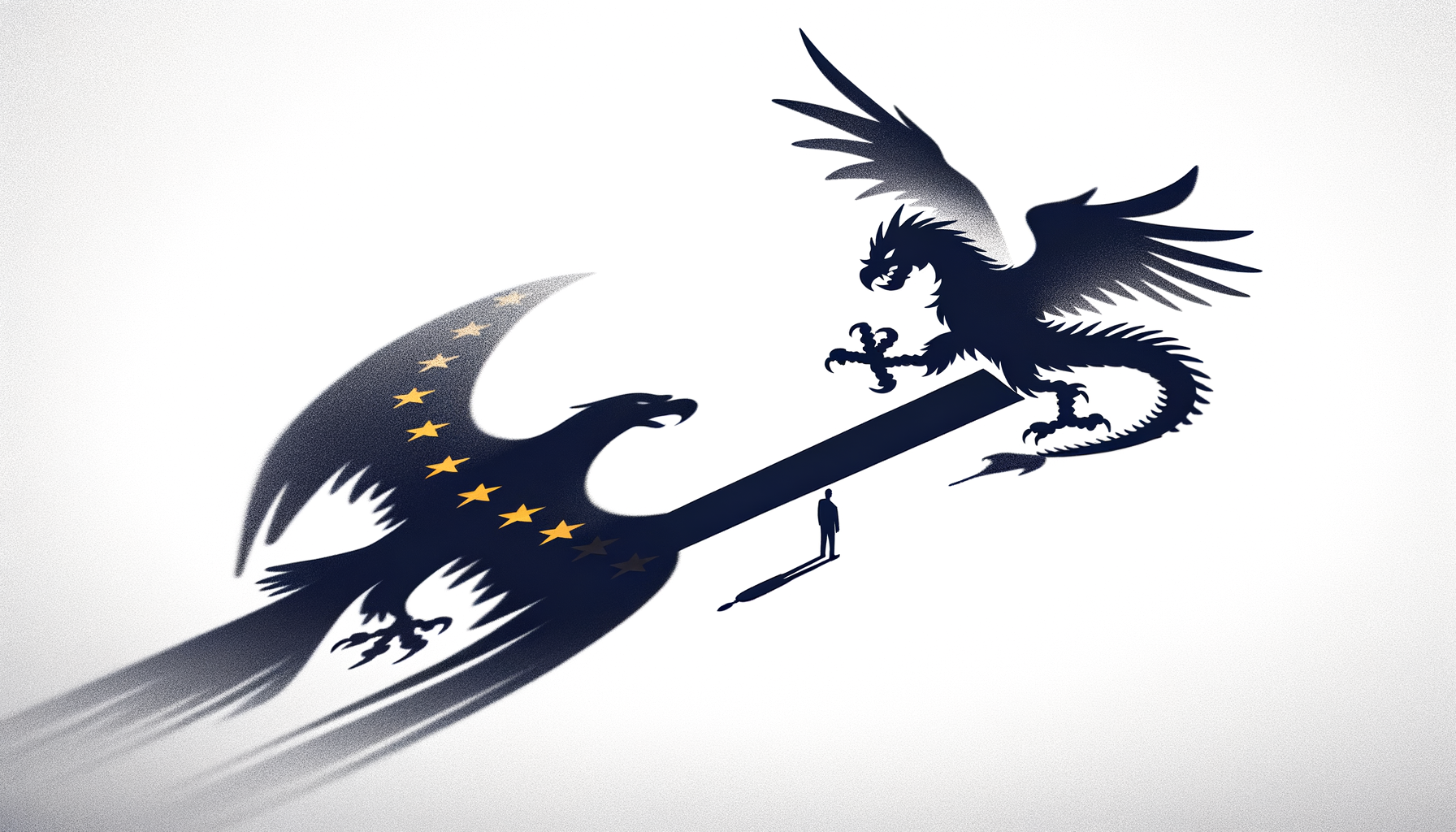
China Isn't the Alternative—It's the Problem
You can complain about Google surveilling you, but no one can seriously claim China's tech will offer less surveillance. And Xi has aimed a gun at the heart of EU manufacturing.
Germany's relationship with China flipped from an €11.4 billion surplus in 2023 to an €87 billion deficit in 2025. That's a 143% swing. China isn't Europe's partner—it's deindustrializing them. German industrial share fell to 20.4% of GDP and dropping.
Plus China can't offer a nuclear umbrella or a blue water navy to protect your energy and supply lines. They're not offering an alternative security architecture—they're offering subjugation without the protection.
Why would Europe embrace the country eating their industrial base while offering nothing in return?
Performance Is All That's Left
Of course Trump is being gratuitous, but he actually shakes the EU up enough to get them to do something. Decades of polite badgering from Obama and Biden didn't work. One Zelensky Oval Office meltdown got the Germans to do the impossible—they actually started spending money on defense.
This reveals the deeper pattern: there is no real strategy for autonomy or a third way. Performance is all that's left.
Canada limiting Chinese EVs to 40,000 units isn't a trade policy—it's theater. Carney's Davos speech wasn't diplomacy—it was a campaign ad for Canadian Prime Minister.

And it worked. Carney's odds of becoming PM jumped from under 1% to around 50% after that speech. He gave voice to something real: the frustration of middle powers caught between superpowers. But giving voice to frustration isn't the same as having options.
The EU leaders running around Davos trying to appease Trump while applauding Carney's defiance proves the point. They know where the real power sits.
The Bottom Line
Carney gave voice to the world middle powers want to live in. But giving voice to it doesn't make it real.
Until European countries change their political model to enable actual strategic decisions—which seems remote—we'll see no real autonomy. Just more eloquent acknowledgments of powerlessness.
Like Viscount Cecil's final League of Nations speech in 1946, Carney's Davos moment was beautifully delivered and utterly beside the point. The world order isn't rupturing. It's consolidating. And middle powers are discovering they're not actually in the middle—they're on the periphery, watching the superpowers decide their fate.
Liberation? No. But sometimes screaming into the void is all you've got left.